
How to Write a Professional Development Plan in 2026 (Step-by-Step Template That Actually Works)

it just needs to be started. Block 90 minutes, open this guide,
and build the roadmap your career deserves.
A professional development plan is the single most powerful tool you can build for your career in 2026 — and most people never write one.
A career doesn’t build itself — and in 2026, hoping for the best is no longer a strategy.
If you’ve already figured out how to choose a career that fits your strengths and the market’s needs, the next critical step is putting that decision into a structured, actionable plan. That’s exactly where most people stall. They know what they want but have no clear roadmap for how to get there.
A strong professional development plan bridges that gap. It turns a vague career goal into a specific, time-bound, skill-driven roadmap — one that keeps you moving forward even when the job market shifts unexpectedly.
This guide walks you through every step, including a ready-to-use template you can start filling in today.
What Is a Professional Development Plan and Why Does It Matter in 2026?
A professional development plan is a personal document that outlines where you are professionally right now, where you want to be, and — most importantly — the specific steps you’ll take to close that gap.
Think of it as a GPS for your professional life. Without it, you’re driving in the right general direction but missing every turn that actually gets you there faster.
In 2026 specifically, a written plan matters more than ever because:
- AI and automation are reshaping roles faster than at any point in recent history
- Employers increasingly value demonstrable progress over passive credentials
- Skill half-lives are shrinking — what’s relevant today may need updating within 24 months
- Career pivots are more common — and more accepted — meaning a flexible plan is more valuable than a rigid one
Without a plan, you react. With one, you lead.
How to Build Your Professional Development Plan: 6 Steps
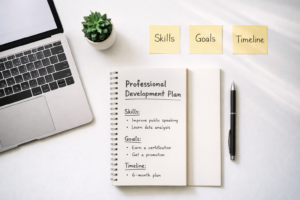
you are, where you want to go, and exactly how you’ll get there.
Download the free template above and start filling it in today.
Step 1: Start With an Honest Self-Assessment
Before writing a single goal, you need a clear picture of where you currently stand. This means looking honestly at three things:
- Your current skills — what can you actually do, and at what level?
- Your strengths and interests — what energises you vs. what drains you?
- Your gaps — what skills, experience, or credentials are you missing for your target role?
Tools like the Holland Code (RIASEC), CliftonStrengths, or even a simple SWOT analysis (Strengths, Weaknesses, Opportunities, Threats) work well here. As a result, you’ll enter the planning stage with real self-knowledge rather than assumptions.
Already done this step? If you’ve followed the 12–24–40 Career Blueprint, your self-assessment answers are your starting point here.
Step 2: Define Your Short, Mid, and Long-Term Career Goals
A strong professional development plan operates on three time horizons simultaneously:
Short-term (0–12 months): These are immediate, actionable targets. For instance, completing a specific certification, landing your first internship, or getting promoted to a senior role. These goals should feel slightly uncomfortable but entirely achievable.
Mid-term (1–3 years): These goals reflect meaningful career progression. Examples include transitioning into a new industry, reaching a management position, or building a freelance client base. Consequently, your short-term goals should feed directly into these.
Long-term (3–10 years): These are your directional goals — where you ultimately want your career to go. They don’t need to be precise, but they should be motivating. Think job titles, income levels, lifestyle outcomes, or the kind of impact you want to have.
The key principle? Each horizon must connect to the next. If your long-term goal is to lead a data science team, your mid-term goal might be leading a small project, and your short-term goal might be completing a Python certification.
Step 3: Identify the Skills You Need to Build
Once your goals are defined, map out exactly which skills are required to achieve them. Specifically, break these into three categories:
Technical skills — role-specific knowledge and tools. For example, a cybersecurity professional needs network security, encryption, and threat detection skills. A UX designer needs Figma, user research methods, and prototyping.
Soft skills — transferable human capabilities. Communication, leadership, emotional intelligence, negotiation, and the ability to give and receive feedback consistently top employer priority lists in 2026.
Domain knowledge — industry-specific understanding. This includes regulatory frameworks, market dynamics, competitor landscape, and emerging trends in your chosen field.
After listing them, rank each skill by two factors: how important it is for your goals, and how large your current gap is. Start with high-importance, high-gap skills first.
Step 4: Build Your Action Plan With Deadlines
This is where most professional development plans fail. People list goals and skills but never attach specific actions or deadlines — and as a result, nothing actually happens.
For every skill or goal, define:
- The specific action (e.g., complete Google Data Analytics Certificate on Coursera)
- The deadline (e.g., by September 30, 2026)
- The success measure (e.g., pass the final assessment with 85%+)
- The resource needed (e.g., $49/month Coursera subscription, 8 hours/week)
This level of specificity transforms a wish list into a project plan. Moreover, it gives you something concrete to review and adjust every quarter.
Step 5: Identify Your Support Network and Mentors
No professional development plan works in isolation. In fact, research consistently shows that professionals with mentors progress faster, earn more, and report higher job satisfaction than those without.
As part of your plan, identify:
- One mentor — someone 5–10 years ahead of you in your target field who can provide guidance, open doors, and help you avoid costly mistakes
- One peer accountability partner — someone at a similar stage who will check in on your progress regularly
- Two to three industry communities — online forums, LinkedIn groups, local meetups, or professional associations where you can stay connected to trends and opportunities
Furthermore, don’t wait until you need something to build these relationships. The best networking happens long before you’re job hunting.
Step 6: Review and Update Your Professional Development Plan Quaterly
A professional development plan isn’t a document you write once and file away. Instead, it’s a living roadmap that needs regular review and honest adjustment.
Every three months, ask yourself:
- Which goals did I make progress on, and which ones stalled?
- What changed in the market or my personal priorities that affects my plan?
- Which skills are now more or less urgent than when I started?
- What do I need to start, stop, or continue doing?
Treat these quarterly reviews like a board meeting with yourself. They’re not optional — they’re the mechanism that keeps your plan relevant and your momentum alive.
Professional Development Plan Template (Ready to Use)
Use this structure to build your own plan today:
Section 1 — Where I Am Now
- Current role / situation:
- Top 3 strengths:
- Top 3 skill gaps:
- Current salary / target salary:
Section 2 — Where I Want to Go
- Short-term goal (12 months):
- Mid-term goal (1–3 years):
- Long-term vision (3–10 years):
Section 3 — Skills I Need to Build
| Skill | Type | Priority | Gap Level | Target Date |
|---|---|---|---|---|
| Technical | High / Med / Low | Large / Medium / Small | ||
| Soft skill | ||||
| Domain |
Section 4 — My Action Plan
| Action | Resource | Deadline | Success Measure |
|---|---|---|---|
Section 5 — My Support Network
- Mentor:
- Accountability partner:
- Industry communities (×3):
Section 6 — Quarterly Review Dates
- Q1 Review:
- Q2 Review:
- Q3 Review:
- Q4 Review:
Common Mistakes to Avoid When Writing Your Professional Development Plan
Even with a solid framework, there are several pitfalls that undermine even the best-intentioned plans. Here’s what to watch out for:
Setting vague goals. “Get better at marketing” is not a goal — it’s a wish. Instead, write “complete HubSpot Content Marketing Certification by October 2026.” Specificity creates accountability.
Ignoring market trends. Your plan should connect to real demand. Therefore, check job boards, industry reports, and salary data before finalising your skill priorities. A skill nobody is hiring for — however interesting — won’t move your career forward.
Planning without acting. A beautifully formatted plan that sits in a folder does nothing. Consequently, link every goal to a calendar event or weekly habit from day one.
Failing to revisit the plan. Circumstances change — industries shift, personal priorities evolve, opportunities appear unexpectedly. As a result, treat your plan as a living document, not a finished product.
Underestimating soft skills. Technical expertise opens doors, but communication, adaptability, and emotional intelligence determine how far you walk through them. Include at least one soft skill goal in every planning cycle.
How a Professional Development Plan Connects to Your Bigger Career Choice
Writing a plan is most powerful when it’s built on a clear career direction. If you’re still working out which path fits your strengths, the market, and your long-term vision, start with the foundational step first — understanding how to choose a career before building the roadmap that follows it.
The two articles work together: the first helps you decide what to pursue, while this one shows you how to pursue it systematically.
Frequently Asked Questions
How long should a professional development plan be? It doesn’t need to be long — in fact, the most effective plans are often one to two pages. What matters is clarity and specificity, not length. A concise, actionable plan beats a comprehensive document that never gets reviewed.
How often should I update my professional development plan? At minimum, review it quarterly and do a full revision annually. In addition, update it immediately whenever something significant changes — a new job offer, a market shift, or a change in your personal priorities.
Can a professional development plan help me change careers entirely? Absolutely. In fact, it’s one of the most valuable tools for career changers because it breaks an overwhelming transition into manageable, sequential steps. The 24-month skill-building window is especially useful for structured pivots.
Do I need a mentor to write a professional development plan? No — you can write one independently. However, having a mentor review your plan dramatically improves its quality. They can identify blind spots, suggest shortcuts, and connect you to opportunities you wouldn’t find on your own.
What’s the difference between a professional development plan and a career goal? A career goal is a destination. A professional development plan is the complete route — including the vehicle, the fuel stops, and the checkpoints along the way. One without the other leaves you either directionless or stuck.
Ready to build your roadmap? Download the template above, block 90 minutes this week, and work through all six sections. Your future self will thank you for starting today — not next month.